RECIPE – JO'S SPRING VEGETABLE SALAD WITH MAPLE YUZU DRESSING
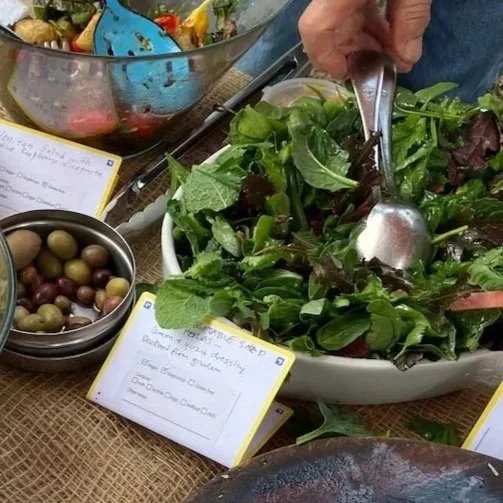
From Spring Long Table lunch, 1 November 2026
This salad was inspired by our first-ever successful broad bean harvest since I’ve been a member, combined with our asparagus, Chioggia beetroot (pickled) and golden beetroot and some of their leaves, mint, parsley and salad leaves from our garden, bolstered by more broad beans, basil and baby red beetroots, baby beans, baby peas and baby spinach sourced elsewhere.
Sources
The recipe is based on three different Yottam Ottolenghi salads and my favourite quick pickle recipe from Kylie Kwong’s book, My China – A Feast for all the Senses. I also substituted quick-brined lemon rind (the ‘cheat’ for when you forgot to make / don’t have) the fermented kind used in the original recipe.
The combination of broad beans with asparagus and green (french) beans is from this Ottolenghi spring salad. I added baby peas for sweetness but omitted the seeds (if making this at home I recommend including them).
The addition of herbs was inspired by this broad bean and herb salad in The Guardian, and the maple-yuzu dressing for the beetroot is from Ottolenghi’s candy beetroot and lentils salad. The recipes for quick pickled vegetables and quick brined lemon peel are below.
Ingredients
Beetroots and dressing
1 -2 medium or 1 bunch baby red beetroot, with leaves
1 -2 medium or 1 bunch baby Chioggia beetroot, with leaves
1 -2 medium or 1 bunch baby golden beetroot, with leaves
(Optional) 1 tbsp preserved or brined lemon rind, finely chopped
(Optional) 1 spring onion, peeled very thinly sliced (or a small bunch of chives, chopped)
(Optional) 1 red chilli, finely diced
5-10 mL (1-2 tsp) sesame oil, to taste
60 mL (3 tbsp) good olive oil
30 mL (1.5 tbsp) lemon juice
15-30 mL (0.75-1.5 tbsp) yuzu or lime juice, to taste
10mL (2 tsp) maple syrup
Green vegetables and leaves
500g broad beans (fresh or frozen), podded (= about 350g after double-podding)
300g medium asparagus (about 12-16 spears), trimmed and sliced on a sharp angle into 3-4 pieces
250g baby french beans, topped and halved on the diagonal
250g baby peas (fresh or frozen)
20g baby spinach and baby beetroot leaves
20g mixed salad leaves, including some bitter and peppery leaves, torn
15g fresh mint leaves, stems removed, torn if very large
15g basil leaves, stems removed, torn if very large
Method
To prepare the beetroot: slice off the tops 2cm above where they join the root (this stops them ‘bleeding’). Soak both the roots and tops in cold water, then scrub the roots thoroughly. Wipe any small perfect leaves with a paper towel or tea-towel and save them for the salad (mini rainbow chard!)
To pickle the Chioggia, cut the off the stems below where they join the root, to remove any remaining grit, then peel them and trim the root. Slice as thinly as possible. If the beetroots are small, you can pickle them as slices; if they are larger, cut the slices into batons. Follow the pickle recipe below.
For the golden and red beetroot, either wrap them separately in foil and roast at 180°C (160°C fan-forced) for 30-45 mins, depending on size, or bring them to the boil - the golden beetroot first, then the red beetroot - in a saucepan with plenty of water, then simmer for about an hour with the lid on. (Don’t cook the Chioggia, it will lose its candy stripes).
When cool, cut off the tops, then slip off the skin. Halve, then cut them into wedges 1cm thick at the base. If needed, cut the wedges again on the diagonal to make them baby beetroot sized. I added the red beetroot pieces to the pickling jar with the Chioggia for a few hours to brighten its flavour (optional).
To prepare the green vegetables, fill a large bowl or very clean sink with cold water. Add ice cubes so it is cold enough to immediately cease cooking. If you are using a sieve to remove the vegetables after blanching, check it fits easily into the saucepan.
Bring a large pot of water to a boil and blanch the asparagus for two to four minutes, depending on thickness – you don't want them too soft. Use the slotted spoon or sieve and tongs to transfer them to the bowl or sink of cold water, leaving the boiling water in the saucepan.
Add the french beans to the boiling water, blanch for up to five minutes, depending on size, then transfer to the bowl/sink as soon as they start to become bright green all over. Repeat for the baby peas, then drain both of them well and spread them out to dry on a clean kitchen towel.
Blanch the broad beans in the same water for two minutes, drain, refresh and dry, then remove and discard the skins by pressing each bean gently between finger and thumb.
Halve the baby beans diagonally, then if the asparagus spears are very thick, halve them lengthwise before slicing diagonally into 3-4 pieces (aim for roughly the same length as the halved beans).
To serve, put all the blanched greens in a large bowl, then layer on the herbs and salad leaves, removing the stems and tearing the leaves into fork-sized pieces as you go.
Add the dressing ingredients to the jar or bowl, and shake or stir to mix. Taste, adjust, add more salt if you like, then dump the beetroot pieces into the centre of the leaves and pour the dressing over the beetroots. Lastly, fold the beetroot gently through the salad to mix the layers together. Serve at once.
Quick-brined lemon rind
No idea where this recipe came from – pre-internet!
Notes:
This recipe doesn’t need to ferment so use as much salt as you like.
Keeping the peel in large pieces makes it easier to deal with.
1 large lemon may yield approximately 1 tbsp brined peel but it varies a lot due to the size of the lemons and thickness of the peel.
More white pith on your peel = more bitterness. If you’re not a fan, this can be reduced by changing the water – but it also slightly reduces the lemon flavour. Alternatively, trim some of the pith off your peels before starting.
Ingredients
Per lemon:
Approx 1 tbsp salt
[sharp vegetable knife or Y peeler]
[small, heavy bottomed saucepan]
[sieve or colander]
Method
Wash the lemons thoroughly to remove any wax.
If you don’t have a ‘Y’ peeler, cut the end off each lemon so it sits flat, then use a sharp knife to carefully slice the peel off from top to bottom while turning the lemon. Save the peeled lemons for juicing.
(Optional) If you are concerned about bitterness, trim some of the pith off the peel. Alternatively, put the peel in the saucepan with enough water to cover it, put the lid on, bring to the boil, then strain off and replace the water. Repeat 1-2 times.
Once you are happy with the peel, place it in the saucepan, cover with water, add the salt, cover with a lid and bring to the boil then turn down to a simmer.
Continue simmering until it has the slightly paler and slightly translucent appearance of preserved lemon rind (usually around 1-3 hours). Rinse well, allow to cool, then finely slice/chop as required.
Quick pickle recipe
Based on recipes in Kylie Kwong's My China - A Feast for all the Senses
Notes
Makes an excellent tasty, crunchy side or prebiotic addition to any hot or cold meal. Try it with: radish (large daikon are good); cauliflower; carrot; fennel bulbs; small whole cucumbers (don’t peel)
Uses only one preservative (vinegar) and does not allow time for much acidity to develop so it must be refrigerated.
Use any vinegar you like, just check that it contains at least 4% acetic acid (I usually use rice wine vinegar for its neutral flavour).
Sugar and salt are just for flavour so use whatever you like, even a sugar replacement like erythritol is fine.
Ingredients
Per 250g of crunchy veg:
2 tsp salt, halved
1 cup vinegar
1/4 cup sugar
100 ml water
(Optional): Seasoning(s) of your choice. Try bay leaf, peppercorns, juniper berries, coriander or caraway seeds, dried mandarin or orange peel, fresh dill etc.
[Lidded jar(s) or container] ideally wide enough to fit your hand in
[Tongs that fit around the jar]
(Optional) [Mandolin]
[Chopsticks &/or a long handled spoon] to arrange the veg in the jar
(Optional) [Pickling weight] small, heavy disc (usually glass) to keep pickles submerged
Method
Sterilise your jar, lid and pickling weight (if you have one) by immersing in a saucepan of water then boiling for 20 mins. Use tongs to grip the outside of the jar and lift it to empty out the water. Stand the jar right-way up on a board or folded tea-towels to cool and air-dry (a cold surface may crack the jar).
Meanwhile prep your veg: peel and fInely shred, slice, cut into ribbons, batons, cubes or florets as desired. Use a mandolin if preferred.
Mix with half the salt, set aside.
To make the pickling liquid, combine vinegar, sugar, remaining salt and water in a small heavy-based saucepan. Add desired seasonings (if using).
Stir over medium heat until sugar/sweetener dissolves then simmer, uncovered and without stirring, for about 10 min. Set aside to cool.
Squeeze salted veg gently to remove moisture and potential air bubbles, rinse and pat dry, then use with spoon/chopsticks to arrange it in the sterilised jar or container.
Fill the jar with cooled pickling liquid, pushing veg down so it is completely covered and air bubbles are released. Tap, tilt and rotate the jar to move remaining air bubbles to the top. Add the sterilised pickling weight if you have one.
Cover tightly with lid and store in the fridge. Consume within 4 weeks.